Welcome to Universal Chiropractic, San Francisco.

Stay tuned for tons of great information about chiropractics specific to San Francisco. To follow us on Twitter and FaceBook click on the corresponding link on the top left of this page.

If you need the services of a professional chiropractor in San Francisco please don't hesitate to call us on (415) 775-2273.

Thursday, May 5, 2011

The Art of Lifting.

You knew you should have lifted the box correctly inside the house but you were rushing and didn't think that it was that heavy and now your back is in spasms and you can't move. This is where the idiom comes in "an ounce of prevention is worth a pound of cure".   Back pain is often caused by everyday bad habits that stress and strain your anatomy.  Learning to lift correctly is not something that everyone learns how to do unless their dad was the moving man or a chiropractor.

Relearning how to lift and move items can help with back pain prevention and something that you want to pass onto your children. Below is a picture of the correct way to lift.  Practice lifting a box when it is relatively light to make sure that you have the correct stance in place and then move on to heavier boxes as you feel more confident.


  1. Avoid twisting and turning motions when you lift.  If you have to turn to place the object, step in the direction of the turn, don't just twist at the waist.
  2. Always bend at your knees, not your waist, when lifting anything heavier than 10 percent of your body weight (e.g. a child or heavy box).
  3. When lifting an object, plant your feet about 12-18 inches apart, kneel or squat in front of the object, and lift as you straighten up. Be sure to lift with the big muscles of your thighs, arms, and shoulders, not with your back.
  4. In some situations, it is difficult to lift correctly. Getting grocery bags out of the car is one such situation.
  5. The car bumper doesn't allow you to bend your knees. Bring the bag to you first and then lift carefully.
  6. When engaging in repetitive lifting, use good lifting form, take frequent breaks, and use equipment to help whenever possible.
  7. To avoid tripping, be sure your path is clear before you lift the item.

Don't forget to use the power of your legs to lift the heavy item and keep the item as close to your body as possible.  If you have injured your back call you local chiropractor and he will tell you what you can do for immediate relief.

Tuesday, March 15, 2011

Feelings of nervousness, irritability and being unable to relax are signs of needing magnesium.

Magnesium influences many bodily functions including digestion, energy production, muscle function, bone formation, creation of new cells, activation of B vitamins and relaxation of muscles, as well as assisting in the function of the heart, kidneys, adrenals, brain and nervous system. Magnesium is an essential mineral.  This means that the body doesn't make it and it must be obtained through the diet.

Hundreds of years ago we would have been able to get our magnesium through our food source as the soil was healthy and full of vitamins and minerals.  The quality of our soil has deteriorated due to the use of fertilizers that contain large amounts of potassium which don't allow vegetables to then absorb magnesium.  So diets are now seriously lacking in the required magnesium and here are some symptoms:

*stress
*low energy
*fatigue/weakness
*PMS and hormonal imbalances
*inability to sleep
*weakening bones
*muscle tension
*muscle spasms
*abnormal heart rhythms
*headaches
*anxiousness
*nervousness
*irritability
*constipation

The second part of this story is the huge impact the calcium has in balancing our magnesium.  Calcium excites nerves, while magnesium calms them down.  Calcium makes muscles contract.  Magnesium is necessary to make muscles relax.  Calcium is needed for blood clotting, but magnesium keeps the blood flowing freely.  It is easy to see that maintaining these minerals in balance is vital and that too little magnesium to balance calcium could be both uncomfortable and and unhealthy.

The solution for getting the correct amounts of calcium and magnesium is in a form that can be completely dissolves in water.  In this state it will absorb quickly into the body, producing fast relief.  Pills need to break down into liquid form before they can be absorbed and not all people, especially as the grow older,  have the capacity to digest these.  The result may be the absorption of little, if any, actual nutrition.

You may already have enough calcium in your diet so won't need to take calcium and magnesium.  In this case you would just need CALM, the magnesium drink.  Any questions?  Well give us a call and we can take a look at your diet and see what your needs are 415-775-2273.

Saturday, February 19, 2011

Massage helps reduce pain.


Massage therapy has been around for thousands of years.  The word "massage" comes from the Greek root "masso" --to touch. 


Muscles which comprise up to 50 percent of your total body weight, can become fatigued, injured or simply achy from chronic stress and tension.  Massage helps restore your muscle and surrounding soft tissue to optimal condition, leaving you refreshed and feeling your best.  The process involves applying pressure to the body's soft tissue by rubbing, kneading or rolling.  There are a variety of techniques and styles, such as deep tissue massage, where deeper layers of muscle and connective tissue are manipulated.  Another approach focuses on trigger points that are painful when pressed.


Massage can help reduce pain, muscle soreness and swelling.  It can improve circulation, joint flexibility and range of motion.  Massage is not a substitute for chiropractic care, massage is not a form of chiropractic, massage is not something you get during an adjustment and vice versa.  Massage is a compliment to an adjustment.  Its benefits are varied and far-reaching.  Many people consider massage a pampering experience, but it has important health benefits.  In fact, like chiropractic you get the greatest benefit when it is part of your regular wellness routine.


Thursday, January 20, 2011

What is the best way to sleep?

Patients often ask me what is the best sleeping position and considering that you may spend up to one third of your night sleeping, it makes perfect sense to pay extra attention to your sleeping position and improve it if necessary.   As sleeping habits are exactly that "habits", they can definitely be changed with some awareness and willingness. 

There are some positions that are better for your back and the overall alignment of your spine.  To keep your back in perfect alignment you should sleep flat on your back, but very few of us do this and there are other options.

Here are the other options:
On Your Side If you sleep on your side, always place a pillow between your knees to prevent your hips from leaning forward and twisting your spine while you sleep. This is especially helpful when suffering of low back pain. 

On Your Stomach: It's not good to sleep on your stomach due to the increased amount of stress placed on your spine. But if you must, then you should raise one leg up slightly and prop a pillow under that knee. It's sort of an enhanced side sleep position. Or you can opt for re-teach yourself how to sleep by taping a soft stress ball to the front of your pajamas – your body will quickly learn that sleeping face down is a very uncomfortable experience! 


One of the most common benefits I hear from patients receiving chiropractic care is that their sleeping is improved.  When you wake up in the morning, you should feel restful, relaxed, regenerated and pain free.  Keeping some of these sleeping tips can help you accomplish this regularly.  Get into the habit of protecting your spine even while you sleep with proper sleeping positions.

Friday, January 7, 2011

Ouch, my head hurts.

I could never say in the morning, "I have a headache and cannot do thus and so". Headache or no headache, thus and so had to be done."   Eleanor Roosevelt

Who hasn't experienced this before, life must go on despite the pain throbbing in your temples.  The common reaction is usually just to reach for the bottle of pain killers. With pain reliever, think long-term.  They only mask the problem, so it is likely to return. This results in the consumption of more medication. Not only is this risky, but very costly.
  
Instead consider chiropractic care.  Chiropractic care is not only safer, but cheaper, less invasive, and long-lasting.  Doctors of chiropractic successfully help thousands of individuals everyday obtain safe, effective, long-term relief from their headaches. This is because most headaches have a spinal, muscular, or habitual component which the chiropractor has been trained to identify and treat. In fact, surveys show that 10-25% of patients initiate chiropractic care for the relief of headaches. 
So don't reach for the pain pills, it's not worth it in the long run.  Getting regular chiropractic care is similar to visiting your dentist.  Routine dental care helps your teeth remain healthy for a long time. The same is true of chiropractic care for your spine. It is important to remember that, just like your teeth, your spine experiences normal wear and tear as you  hunch over the computer, sit in traffic, rush to take the stairs to get to your appointment on time and slump on the couch watching t.v.
All sound familiar?  Do yourself and your body a favor, make an appointment with your chiropractor to resolve your headaches once and for all.

Tuesday, December 28, 2010

Video Games don't have to be a Pain in the Neck.


One hundred fifty years ago, most men, women and children performed tasks each day that taxed the muscles of their trunks in every direction. This led to a balanced upper body, roughly equal strength in the muscles of the front, back and sides of the torso. Good posture was a natural result.


Today kids have bad postures and so many more body ailments because they have lost their core stability.  As children's overall fitness has declined, the muscles in their abdomen, upper back, shoulder and lower back have become soft as well.  Why have they lost their core stability?  A huge part is because of the increased amount of sitting.  The average teenager spends around 14 hours a week playing video games.  This doesn't include T.V. time or the average 4 hours a day sitting at school.

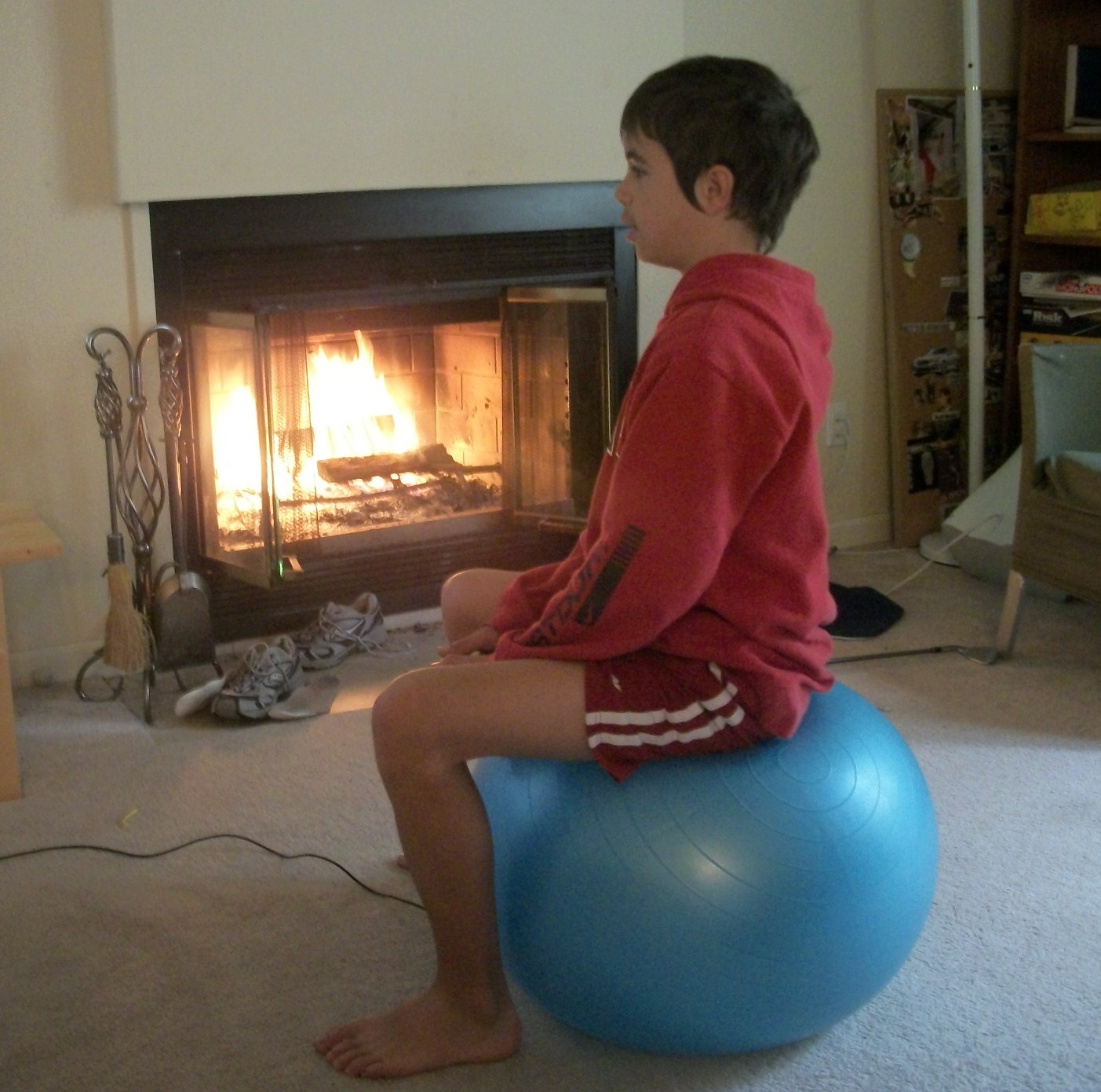
Here are some tips that you can do to help get over the video game slump with your kids.  They are fun and the stability ball is a really great idea that will help with everyone's posture.

Video-game exercise: Games which require motion like the Wii and play station 3 games are better than other video games that require nothing more than sitting on a couch.  They have all kinds of games that will have the kids moving their bodies. 

Stretch breaks. Micro breaks for children and adults, during which you get up and exercise the muscles opposite to the ones you use while sitting. So stand up from that video game, reach your hands above your head and lean back for short stretches.

Stability balls. Replace comfy chairs with stability balls. Doing so allows children to engage those core muscles, even while they're playing video games.  When they are taking in turns with the games there are so many fun exercises that they can do.  It really is a great investment for your kid's health.


It's never too late to change bad habits and create new ones as habits are created by repetition. Your mind and body create bigger and stronger connections with each repetition.  So sitting tall when playing video games, stretching out the body are simple steps that can be very effective when playing video games.